Puppy Leash Training: Collar, Harness and First Walks
Affiliate disclosure: we may earn a commission from the program mentioned below. How this works.
Short answer
You can start leash training as soon as your puppy comes home, indoors. Choose a well-fitted harness, introduce it and the leash slowly with treats, let your puppy drag the leash around the house, then practice walking beside you indoors. Keep first outings short and calm, let your puppy set the pace, and ask your vet which places are safe before vaccinations are complete.
Not sure where to start? Take the 2-minute quiz for a first-week plan.
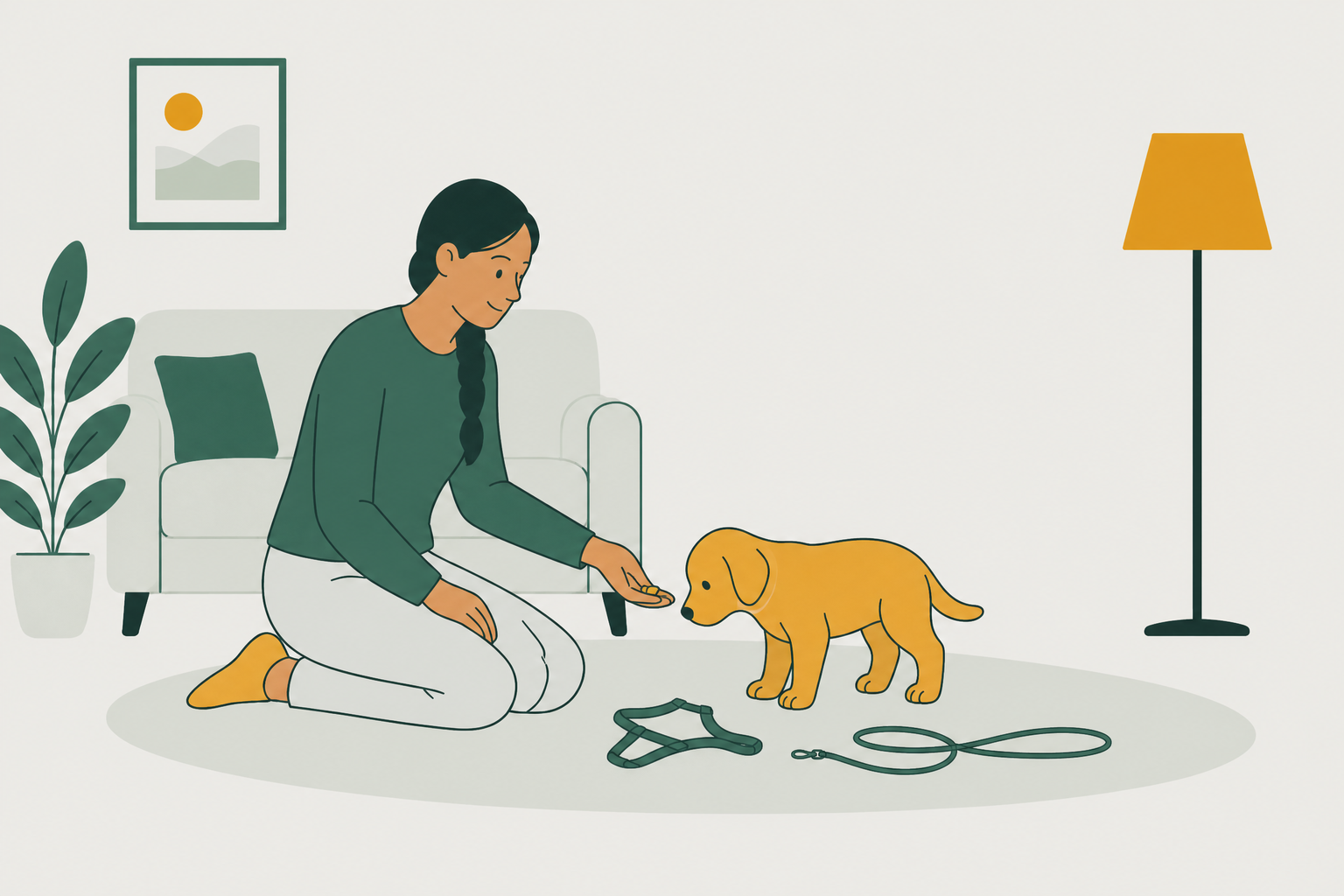
A puppy doesn’t arrive knowing what a leash is. Megan Stanley, an Association of Professional Dog Trainers board chair quoted by PetMD, puts it simply: people assume a leash is natural to a dog, but it isn’t. This guide covers what’s specific to puppies: when to start, choosing and introducing the gear, and planning first walks around vaccines and socialization. For the loose-leash method itself, see our guide to loose-leash walking.
When can you start leash training a puppy?
The AKC says the first steps in leash walking can begin as soon as you bring your puppy home, starting indoors. Going out in public takes a little more planning, because your puppy is still being vaccinated, but it’s also the best window for socialization.
VCA Animal Hospitals explains that you can safely take a young puppy out in public with some precautions. It calls waiting for the full vaccination series a misconception: by the time the series is finished, the sensitive period for socialization is over, and puppies without well-timed socialization face a considerable risk of lasting fears. VCA’s precautions:
- follow your veterinarian’s vaccination schedule and ask about disease risks in your area;
- avoid unvaccinated dogs and groups of unknown dogs, such as dog parks;
- meet only healthy, vaccinated dogs you trust to be gentle with your puppy.
A rough plan by age (ask your vet to adjust it for your puppy):
| Age | Leash goals | Where | Read more |
|---|---|---|---|
| First days home | Get used to the harness and leash, with treats | Inside | Steps 1 to 3 below |
| About 8 to 12 weeks | Walk beside you for a few steps; short, calm outings | Home, yard, quiet places your vet approves | Puppy stages by age |
| About 3 to 4 months | Short walks in new places, with plenty of treats | Quiet streets, pet-friendly shops (VCA) | Socialize safely |
| About 4 to 6 months | Loose-leash walking with gradually more distractions | Busier places, step by step | Loose-leash walking |
Collar or harness for a puppy?
The AKC says a harness is generally the better option for puppies, so there’s no pressure on their neck if they pull. For large puppies, its trainer suggests a front-clip harness, which makes it easier to direct them if they start pulling. Whatever you choose, the AKC says it must fit so your puppy can’t slip out and it doesn’t restrict their movement.
VCA Animal Hospitals’ veterinary behaviorists add:
- Fit. A well-fitted harness doesn’t limit the front legs and shouldn’t rub behind the elbows. Our guide to a dog who won’t walk on a leash has a quick fit check. Puppies grow fast, so check the fit often.
- A collar for ID. A flat collar easily holds identification tags.
- Supervision. Remove any collar or harness when your puppy isn’t supervised, since gear can get caught and cause injury.
- No discomfort. Avoid devices designed to create discomfort, and never snap or jerk the leash.
Short-muzzled breeds such as French Bulldogs need a harness rather than a collar; our loose-leash guide explains why in leash walking by age and breed.
Puppy leash training, step by step
Step 1: Make the gear predict good things
VCA says any new equipment should be introduced gradually and gently in a safe, quiet space, and that your puppy should be used to it before you use it on walks. Stanley’s advice is to bring the collar or harness out, let your puppy sniff and explore it, and pair it with food rewards before putting it on (PetMD). Our loose-leash guide has the step-by-step pairing: show and treat, slip on and treat, buckle and treat.
Step 2: Let the leash drag around the house
Once your puppy is comfortable in the collar or harness, attach the leash and let them drag it around, rewarding them as they move (PetMD). Stay with them the whole time, so the leash can’t get caught on furniture.
Step 3: Pick up the leash, and follow first
Next, pick up the leash and let your puppy lead you where they want to go, within reason. Stanley says that only once your puppy is comfortable wearing the gear and having you on the other end of the leash should you start directing their movements (PetMD).
Step 4: Teach “be near me” indoors
The AKC’s trainer starts with a marker: say “yes” or click, then treat, until your puppy perks up at the sound. Then mark and reward your puppy any time they offer eye contact or stay close to you, and add a cue such as “let’s go” as you walk, rewarding every few steps. Our loose-leash guide covers this in Step 1 and Step 2.
Step 5: Plan short, calm first outings
VCA suggests bringing your puppy to new places at least twice a week, with tasty treats, starting at a comfortable distance from anything that might frighten them. If your puppy looks calm, move closer; if they seem concerned, give more distance. Let your puppy set the pace and sniff. The AKC suggests keeping puppy training sessions to five to 10 minutes and always ending on a positive note.
A simple checklist for each early outing:
| Before | During | After |
|---|---|---|
| Harness fitted, ID collar on, treats ready | Let your puppy watch from a distance first | Note what went well and what worried your puppy |
| Potty break and a short play | Reward every check-in and every few steps beside you | Next time, start where your puppy was relaxed |
| A quiet place your vet is happy with | Avoid dog parks and unknown dogs (VCA) | Time for a nap: the AKC notes naps after play or walks help prevent overtiredness |
Step 6: Move on to loose-leash walking
When your puppy walks beside you indoors and copes well outside, start the loose-leash method: stop when the leash goes tight, move when it loosens, and add distractions one level at a time. Our guide explains what to do when the leash goes tight and the distraction ladder. The AKC recommends moving outside only once your puppy understands loose-leash walking inside your house or yard.
Common mistakes
- Expecting a puppy to “just walk”. Stanley says most people expect their puppy to understand the leash and walk nicely right away; outside there are smells, people and wildlife to deal with (PetMD).
- Dragging a puppy who stops. The AKC’s trainer says we should communicate clearly where we’re going, so puppies aren’t just getting dragged along. If your puppy sits and won’t move, see our guide to a dog who won’t walk on a leash.
- Waiting until every vaccine is done to go anywhere. VCA calls this a misconception; ask your vet about low-risk outings instead.
- Dog parks and unknown dogs too early. VCA advises avoiding them while your puppy is still being vaccinated.
- Leaving gear on when no one is watching. Remove the harness or collar when your puppy is unsupervised (VCA).
Different puppies, different plans
Large-breed puppies. A front-clip harness makes it easier to direct them if they pull (AKC).
Shy or sensitive puppies. Give more distance and more time. VCA’s rule is to start at a comfortable distance and move away if your puppy seems concerned.
Puppies who bite the leash. Mouthing is normal in puppies; our biting guide covers common biting situations, including the leash.
Puppies starting later. An adult or adolescent dog who never learned the leash follows the same steps, but Stanley notes it usually takes longer (PetMD).
When to get help
Talk to your veterinarian about when and where your puppy can safely go before vaccinations are complete. A good puppy class can help with leash skills and socialization; our puppy guide explains how to choose one. If your puppy seems very frightened outside, freezes or tries to flee, slow down and ask your vet or a qualified reward-based trainer for help.
Not sure where to start? Take the 7-question quiz and get the guide for your result by email.
Frequently asked questions
When can I start leash training my puppy?
The AKC says the first steps can begin as soon as you bring your puppy home: get them used to wearing a harness with the leash attached, and reward them for it. Start indoors, where there's little to distract them, and move outside once they understand walking beside you inside.
Should a puppy wear a collar or a harness?
The AKC says a harness is generally the better option for puppies, so there's no pressure on the neck if they pull, as long as it fits so your puppy can't slip out and it doesn't restrict their movement. VCA notes that collars are useful for carrying identification, and that any collar or harness should be removed when your puppy isn't supervised.
Can I walk my puppy before all their vaccinations?
Ask your veterinarian. VCA Animal Hospitals says you can safely take a young puppy out in public with some precautions, because by the time vaccinations are finished, the sensitive period for socialization is over. Avoid unvaccinated dogs and groups of unknown dogs, such as dog parks, and follow your vet's vaccination schedule.
How long should a puppy's first training sessions be?
Short. The AKC suggests keeping puppy training sessions brief, about five to 10 minutes, and always ending on a positive note. First outings work the same way: a few calm minutes are worth more than a long walk.
Sources
- How to train a dog or puppy to walk on a leash — American Kennel Club
- Why your dog won't walk on the leash, from dog training to health issues — PetMD
- Collar and harness options for dogs — VCA Animal Hospitals (Ellen Lindell, VMD, DACVB; Monique Feyrecilde, LVT, VTS (Behavior); Debra Horwitz, DVM, DACVB; Gary Landsberg, DVM, DACVB)
- Puppy Behavior and Training: Socialization and Fear Prevention — VCA Animal Hospitals
- How much do puppies sleep? — American Kennel Club
- Teach your puppy these 5 basic commands — American Kennel Club
Related guides
 Loose-Leash Walking: How to Stop a Dog Pulling
Why dogs pull on the leash, and a step-by-step force-free plan to teach loose-leash walking, with gear that helps and fixes for lunging and stopping.
 Dog Won't Walk on a Leash? Causes and Gentle Fixes
Why dogs stop, sit or lie down on walks, how to rule out pain and a badly fitted harness first, and a gentle plan to make walking worth it, never dragging.
 Leash Reactivity: Why Dogs Lunge and Bark at Other Dogs
Why dogs lunge and bark at other dogs on leash, how to tell frustration from fear, and a force-free, step-by-step plan to help them stay calm on walks.