Puppy Crying in the Crate at Night: What Helps
Affiliate disclosure: we may earn a commission from the program mentioned below. How this works.
Short answer
A new puppy usually cries in the crate at night because they miss their littermates, feel unsure in a new place, or need to go out. Keep the crate next to your bed, give a few quiet minutes to settle, then take a quick, boring potty trip if crying continues. Never punish crying, and practice the crate in the daytime.
Not sure where to start? Take the 2-minute quiz for a first-week plan.
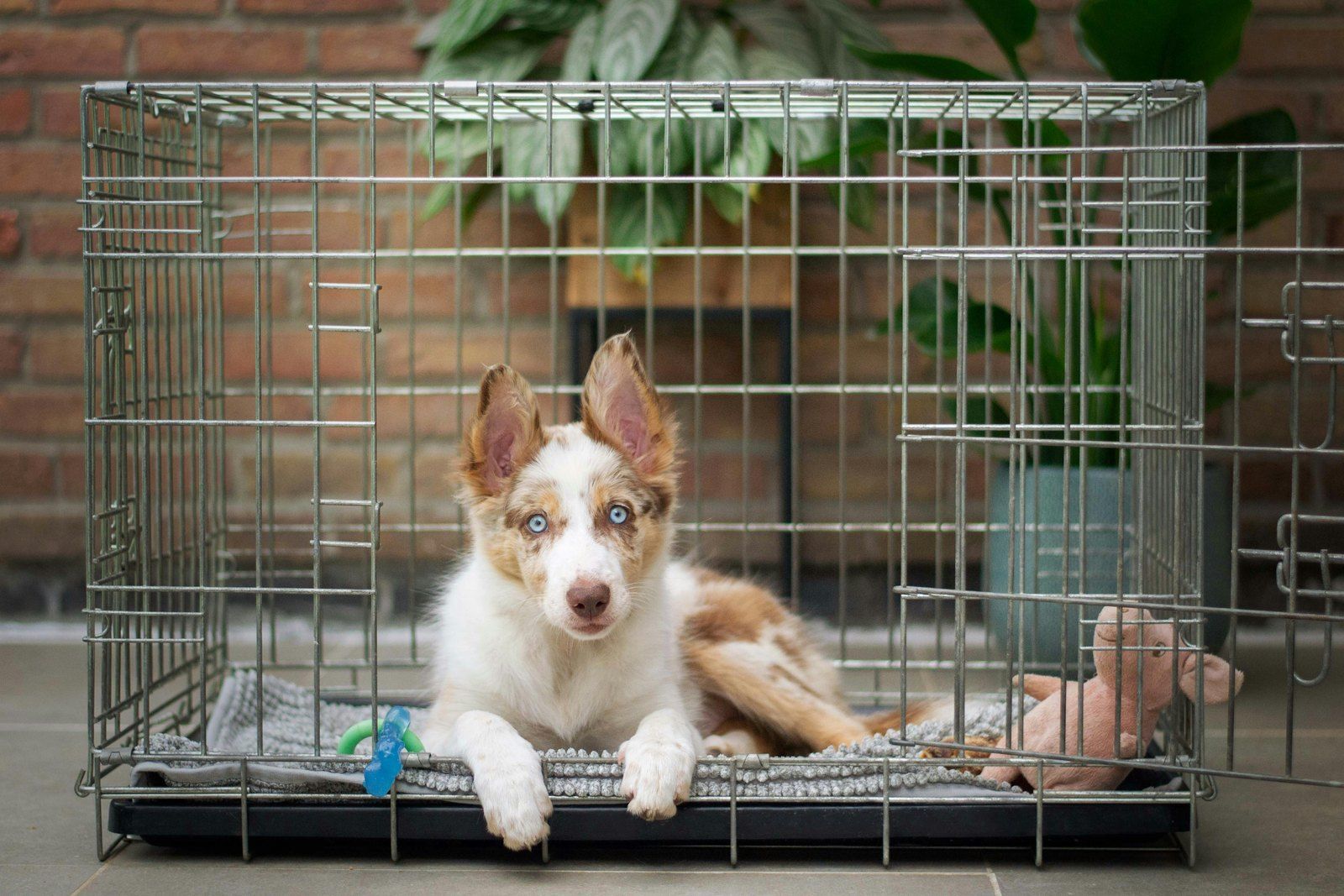
It’s 2 a.m., your new puppy is crying in the crate, and you’re wondering whether to go to them or wait it out. Both can be right, depending on why they’re crying. This guide helps you read the cry and respond in a way that helps your puppy settle, night after night. For the full first-night setup and the rest of your puppy’s first months, see our puppy training guide.
Why do puppies cry in the crate at night?
PetMD’s veterinary behaviorist, Dr. Wailani Sung, lists five common reasons:
| Reason | What it looks like | What helps |
|---|---|---|
| Fear of the crate | A puppy who has never been introduced to a crate cries in an unfamiliar space | Daytime crate practice (Step 4 below) |
| Missing littermates | Crying soon after lights out, especially the first nights | Crate next to your bed, your hand nearby |
| Distress at being alone | Crying when you leave the room | Short, gentle practice; get help if it turns to panic |
| Wanting attention | Crying when family members are still up and moving around | Wait for a few seconds of quiet before you respond |
| Needing to go out | Crying after a long stretch in the crate, or in the middle of the night | A quick, boring potty trip |
The timing is your best clue. Crying right after bedtime is usually about settling in; crying a few hours later is more often a full bladder.
How to help your puppy settle: step by step
Step 1: Set up the crate where you sleep
The AKC suggests putting the crate in your bedroom, so your puppy feels more secure with you nearby, with a blanket or soft toy that smells like their mother if you can get one. You can put the crate right next to your bed and put your hand inside to reassure them. Humane World for Animals suggests the crate be large enough for your puppy to stand up and turn around in.
Step 2: Give a few quiet minutes, then check
Sources differ slightly on how long to wait:
- PetMD’s veterinary behaviorist says it’s OK to let a puppy cry for a few minutes to settle on their own, but to respond if crying lasts more than about two minutes or escalates.
- Humane World for Animals suggests ignoring whining for several minutes if your puppy hasn’t been rewarded for it before. If it continues, say your “go potty” phrase; if your puppy responds eagerly, take them out.
What they agree on: a short wait is fine, and a puppy should never be left screaming for hours (PetMD).
Step 3: Make night trips quick and boring
If your puppy needs to go, the AKC suggests quietly carrying them out for a quick, boring potty break, then putting them straight back in the crate.
Prefer to watch? Step 3, quick and boring night trips, in a 42-second video:
To plan ahead, PetMD offers a rule of thumb: your puppy’s age in months plus one gives the most hours they can hold their bladder.
| Puppy’s age | Most hours between trips (PetMD rule of thumb) |
|---|---|
| 2 months | About 3 |
| 3 months | About 4 |
| 4 months | About 5 |
Humane World for Animals adds that puppies under six months shouldn’t stay in a crate for more than three or four hours at a time, so a young puppy will need at least one trip during the night. Our house training guide has full potty schedules by age.
Step 4: Make the crate a good place in the daytime
Night crying is easier to fix when the crate already feels safe during the day. Humane World for Animals describes a gradual routine:
- Leave the crate open in a family area and drop treats near it, then inside it. Don’t force your puppy in.
- Feed meals near the crate, then gradually move the bowl further inside. Once your puppy is eating comfortably inside, close the door during the meal.
- Practice short periods in the crate while you’re home, then gradually increase the time.
The AKC also suggests keeping crate time rewarding with surprise treats and food-stuffed toys. PetMD suggests placing the crate where the family spends time during the day, with comfortable bedding and age-appropriate toys.
Step 5: Reward quiet, not crying
The AKC’s trainer advises never letting a puppy out of the crate while they’re whining, because it teaches them that crying is the way out. Wait for a few seconds of quiet, then open the door. The exception is a genuine potty need: take them out, but keep it quick and calm.
Common mistakes
| Mistake | Why it backfires | Do this instead |
|---|---|---|
| Opening the door during crying | Crying becomes the way out (AKC) | Wait for a few seconds of quiet |
| Leaving a puppy to scream for hours | Builds fear of the crate (PetMD) | Respond if crying escalates; check for a potty need |
| Using the crate as punishment | Spoils the crate as a safe place (Humane World) | Only good things happen in the crate |
| Turning night trips into playtime | Waking up becomes rewarding | Quick, quiet, straight back to bed |
| Moving the puppy into your bed on night one | Hard to undo if that’s not your plan (AKC) | Crate next to the bed, hand inside |
Different puppies, different nights
Very young puppies (8 to 10 weeks) usually need more night trips, as the bladder rule above shows. Plan for them rather than waiting for crying.
Puppies who were never crated before may be crying from fear of the crate itself, one of the reasons PetMD lists. Spend a few days on daytime practice before expecting quiet nights.
Older puppies and adolescent dogs who start crying in a crate they used to accept deserve a closer look at what has changed in their day: exercise, schedule or time alone. Our guide to dog barking at night covers night-time noise in older dogs, and our adolescence guide explains what changes in the teenage months.
When to get help
The AKC notes that crate training can take as little as a day or as long as several months, depending on the dog. Talk to your veterinarian and a qualified behavior professional if:
- your puppy seems panicked or won’t stop crying. The AKC advises stopping crate training and getting help from a professional trainer or behavior consultant;
- crying continues for weeks with no progress. PetMD’s veterinary behaviorist suggests a board-certified veterinary behaviorist or a certified applied animal behaviorist;
- your puppy is distressed whenever you leave, not only at night. Humane World for Animals notes that a crate won’t fix separation anxiety; see our separation anxiety guide.
Not sure where to start? Take the 7-question quiz and get the guide for your result by email.
Frequently asked questions
How long until a puppy stops crying in the crate at night?
There's no fixed timeline. PetMD veterinarian Brittany Grenus says it's very common for puppies to cry their first few nights, or even weeks, at home. Keep following the steps above, and watch the trend over several nights. PetMD's veterinary behaviorist warns that a puppy should not be screaming for hours, and suggests professional help if you're not making progress.
How long should I let my puppy cry in the crate?
Only briefly. PetMD's veterinary behaviorist says it's OK to let a puppy cry for a few minutes to give them a chance to settle, but if crying goes on for more than about two minutes or gets worse, respond. Humane World for Animals suggests ignoring whining for several minutes, then checking whether your puppy needs to go out. A puppy should never be left screaming for hours.
Should I let my puppy sleep in my bed instead?
The AKC's advice is not to put a crying puppy in your bed unless that's where you want them to sleep long term. You can put the crate right next to your bed and put your hand inside to reassure them.
How often does a puppy need to go out at night?
PetMD suggests a rule of thumb: take your puppy's age in months and add one to estimate the most hours they can hold their bladder. A 2-month-old puppy can hold it for about three hours at most, so expect night trips at first.
Is my puppy crying from separation anxiety?
Most puppies cry while they adjust. If your puppy seems panicked or won't stop crying, the AKC advises stopping crate training and getting help from a professional trainer or behavior consultant. Humane World for Animals notes that a crate won't fix separation anxiety.
Sources
- Puppy Crying in His Crate? Here's What To Do — PetMD (Wailani Sung, MS, PhD, DVM, DACVB)
- Crate training 101 — Humane World for Animals
- Safe and stress-free crate training: a step-by-step guide — American Kennel Club (Stephanie Gibeault, MSc, CPDT)
- Your first day at home with a new puppy — American Kennel Club (Harriet Meyers)
- 5 tips for surviving your first night with a new puppy — PetMD (Brittany Grenus, DVM)
Related guides
 Puppy Training Guide: The Stages of Training a Puppy
A force-free puppy training guide organized by age: socialization, potty training, sleep, biting and first cues, and what matters most early on.
 Dog Adolescence: Why Your Trained Puppy Forgot Everything
Why dogs seem to forget their training between about 6 and 18 months, what's normal in the teenage phase, and a force-free plan to get through it together.