Crates and Separation Anxiety: Help or Harm?
Short answer
A crate does not treat separation anxiety. Humane World for Animals warns that an anxious dog may still panic inside and can get injured trying to escape. Some dogs do see the crate as a safe place, so film your dog in it: heavy panting, drooling, frantic escape attempts or nonstop barking mean you should use a safe room behind a baby gate instead.
It’s tempting to think a crate will solve the damage: if your dog can’t reach the door frame, they can’t chew it. But for a dog who panics when alone, the crate changes where the panic happens, not the panic itself. Here’s what the evidence says, how to tell whether your own dog is coping in a crate, and what to use instead while you train.
Does a crate help a dog with separation anxiety?
Not as a treatment. Humane World for Animals puts it plainly: using the crate as a remedy for separation anxiety won’t solve the problem. A crate may prevent destruction, but your dog may get injured trying to escape, and an anxious dog will still urinate, defecate, howl or panic inside it.
That doesn’t mean every dog with separation problems must never see a crate. The ASPCA explains that crate training can help some dogs who have learned that the crate is their safe place, while for others the crate adds stress. The only way to know which one your dog is: watch.
Why do some anxious dogs panic in a crate?
- The fear is about being alone, not about space. Humane World for Animals notes that dogs keep showing anxiety responses inside a crate.
- Confinement can add stress. The ASPCA lists heavy panting, excessive salivation, frantic escape attempts and persistent howling or barking as signs the crate is making things worse.
- Escape attempts hurt. The ASPCA describes dogs with separation anxiety breaking teeth and scraping paws trying to get through doors and windows. A crate is one more barrier to fight.
- Forcing it can backfire. VCA’s veterinary behaviorists warn that some dogs become distressed more and more quickly, “sensitized” instead of desensitized.
Crate check: coping or panicking?
| Signs your dog is comfortable in the crate (Humane World) | Signs the crate is adding stress (ASPCA) |
|---|---|
| Eats meals calmly in the crate | Heavy panting |
| Rests quietly for about 30 minutes | Excessive drooling |
| Goes in willingly when asked | Frantic escape attempts, chewing or pushing at the door |
| Sleeps comfortably through the night | Persistent howling or barking |
How to decide whether to crate your dog: step by step
- Start while you’re home. Use the crate only when your dog already goes in willingly. If not, start with the step-by-step crate training in our puppy training guide, which works for adult dogs too.
- Film a short absence with your dog crated. Keep it shorter than the time your dog copes alone, and compare what you see with the table above.
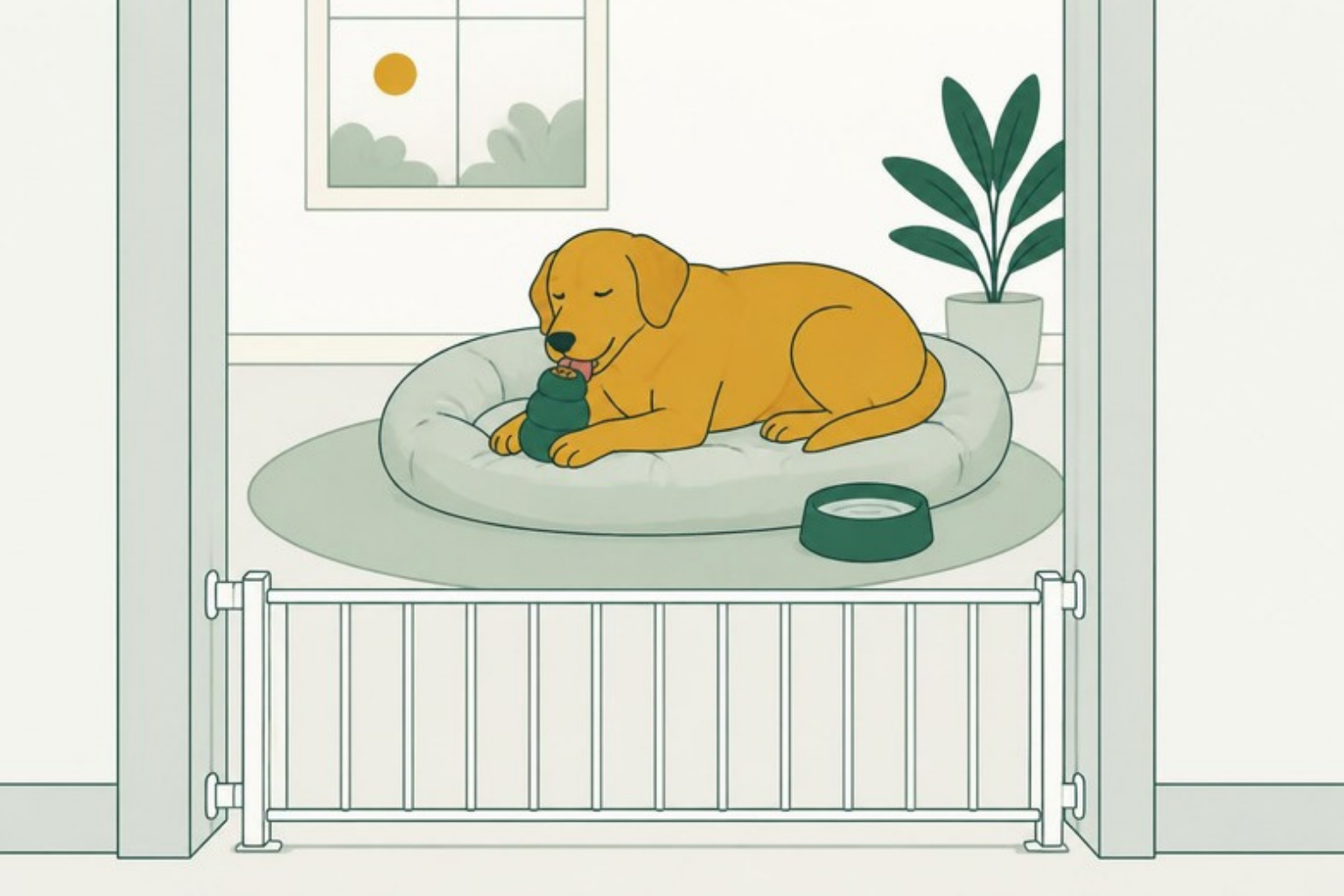
- If you see stress signs, stop crating for absences. The ASPCA suggests confining your dog to one room behind a baby gate instead. Humane World for Animals suggests a safe room with windows and comforting items.
- If your dog is relaxed, keep the crate pleasant. Humane World for Animals’ rules: link it with something pleasant, such as treats and meals, and never use it as punishment.
- Respect time limits. Humane World for Animals says puppies under six months shouldn’t stay in a crate for more than three or four hours at a time.
- Treat the anxiety itself. Humane World for Animals says separation anxiety can only be resolved with counterconditioning and desensitization. Our separation anxiety guide shows how to start with very short absences.
Safer setups while you train
- A safe room behind a baby gate, with your dog’s bed, water and something to chew (ASPCA, Humane World).
- Avoid absences longer than your dog can handle. A pet sitter, a friend, doggy daycare if your dog enjoys it, or taking your dog with you, as our separation anxiety guide explains.
- Keep a camera running so you can see whether the new setup helps, as VCA’s veterinary behaviorists recommend.
Common mistakes
- Crating to stop the damage. It moves the panic into the crate and risks injury (Humane World).
- Using the crate as punishment. Humane World for Animals’ first rule is that the crate is always linked with something pleasant.
- Pushing a stressed dog in and leaving. VCA warns that some dogs become more sensitive, not less, when exposed too fast.
- Ignoring a damaged crate. Bent bars or a chewed tray are evidence of escape attempts, one of the signs the ASPCA lists. See the signs of separation anxiety.
Puppies, adult dogs and senior dogs
Puppies usually learn to rest in a crate with gradual, positive training, and crying in the first nights is often about missing littermates or needing to go out. Our guide to puppy crying in the crate covers what helps.
Adult and rescue dogs may have never been crated, or may link the crate with a stressful past. Film before relying on it. If damage at home is the main problem, see our guide to dogs who destroy things when left alone.
Senior dogs who suddenly struggle in a crate they used to accept should see a veterinarian: VCA lists medical conditions and cognitive changes among the causes of distress when alone.
When to get help
Stop crating and call your veterinarian if your dog has hurt themselves trying to escape, damaged the crate, or shows panic on video. VCA’s veterinary behaviorists advise consulting a veterinary behaviorist if your dog doesn’t tolerate even a short departure, and the ASPCA recommends a certified applied animal behaviorist (CAAB) or a board-certified veterinary behaviorist (DACVB) for moderate and severe cases.
Not sure where to start? Take the 7-question quiz and get the guide for your result by email.
Frequently asked questions
Should I crate my dog if they have separation anxiety?
Only if your dog is already relaxed in the crate. The ASPCA says a crate can help some dogs who see it as their safe place, but causes added stress for others. Film your dog crated before relying on it.
Why does my dog destroy the crate when I leave?
Breaking out of or chewing a crate is one of the escape attempts the ASPCA lists as a sign of separation anxiety. Humane World for Animals warns that dogs can injure themselves trying to escape, so stop crating and talk to your veterinarian.
Is it cruel to crate a dog?
Not when the crate is a comfortable place your dog chooses to rest in, it's never used as punishment, and time limits are respected. Humane World for Animals says puppies under six months shouldn't stay in a crate for more than three or four hours at a time.
Sources
- Crate training 101 — Humane World for Animals
- How to calm a dog with separation anxiety — Humane World for Animals
- Separation Anxiety — ASPCA
- Dog Behavior Problems - Separation Anxiety — VCA Animal Hospitals (Ellen Lindell, VMD, DACVB; Debra Horwitz, DVM, DACVB; Gary Landsberg, DVM, DACVB)
Related guides
 Dog Separation Anxiety: A Step-by-Step Training Plan
A gradual, force-free plan to help a dog with separation anxiety feel safe home alone: short practice absences, boring departures and when to see your vet.
 Signs of Separation Anxiety in Dogs and What to Do
The signs of separation anxiety in dogs, when they show up, what else can look like it, and how to check your own dog with a simple video before you start.
 Dog Destroys the House When Left Alone? Start Here
Is it separation anxiety, boredom or a chewing phase? How to tell why your dog destroys things when alone, keep them safe, and which plan to follow next.